English Language Guidelines on Lyme disease
None of the guidelines incorporates all the published knowledge on Lyme disease and because of the lack of quality European clinical trials, there is significant disagreement on both diagnosis and treatment. All these references should be read in this context.
UK Guidelines
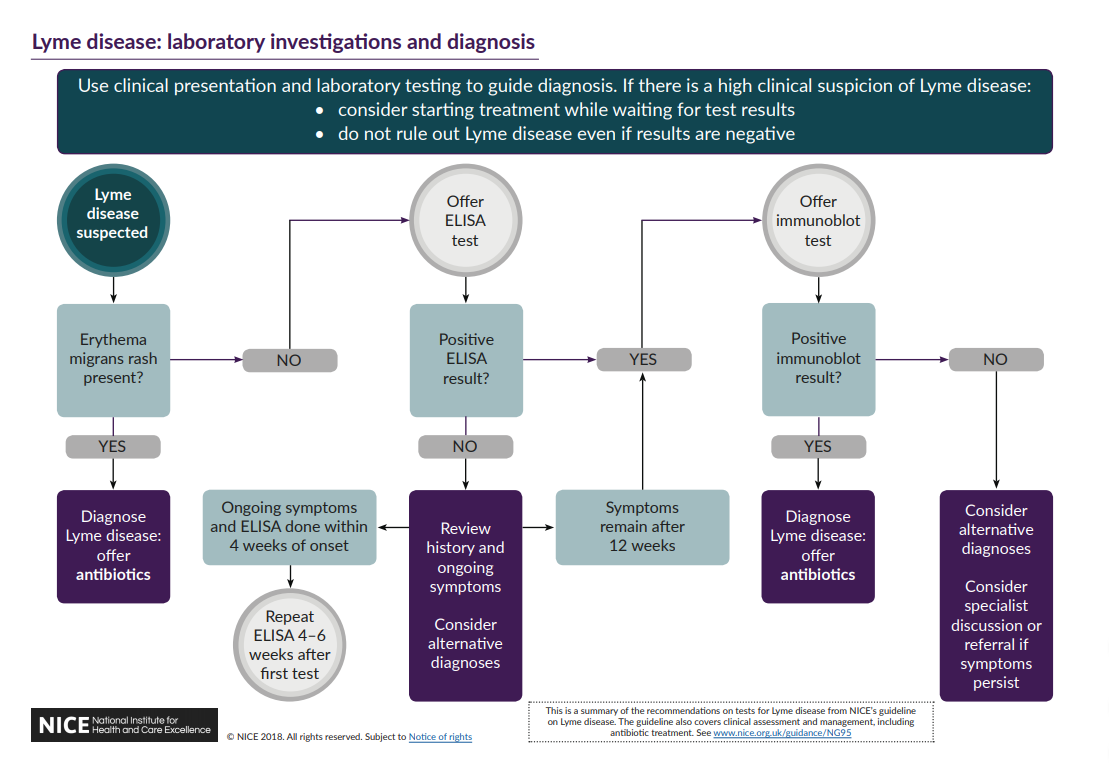 A NICE Guideline was published in April 2018.
As well as detailed information on awareness, diagnosis and treatment, NICE have published a Visual Summary which guides a healthcare professional through laboratory investigations and diagnosis.
LDA, as a registered stakeholder, provided feedback on the draft guideline and an LDA trustee was a member of the Guideline Committee. You can read LDA’s reaction to this guideline here.
Points to note:
- If erythema migrans is present, diagnose and treat without testing
- If clinical suspicion of Lyme disease is high, consider starting treatment while waiting for the test result
- Do not rule out Lyme disease even if test results are negative
- The NICE Guideline process does not consider small studies or emerging science when assessing evidence.
NICE Clinical Knowledge Summaries CKS for Primary Care
Points to note
- Is intended for Primary Care clinicians.
- Has a useful differential diagnosis section.
- Provides information on the Jarisch-Herxheimer reaction that may occur near the start of treatment.
- The Management section includes actions to consider for patients with continuing symptoms.
The British Infection Association (BIA) published a position statement on Lyme disease in their own journal in 2011.
Points to note:
- NB Some treatment recommendations are misquoted and incorrect; these pose a risk to patients.
- This is not a set of guidelines and has therefore not been drawn up using recognised procedures for guidelines.
- The full BIA position paper can be read on the BIA’s website (click the Organism tab) where it is presented as if it is a properly developed guideline; very misleading for doctors.
- The statement appears to be a presentation of evidence to support an already confirmed view, rather than a discussion of the present state of knowledge concerning Lyme disease.
- Lyme Disease Action has some serious concerns about this position statement and has issued a detailed comment paper.
The UK Health Security Agency (UK HSA)has some pages on the DH.GOV webpages
Points to note:
- Provides a good document for the public with useful points to draw to your GP’s attention.
- Mentions LDA for support and advice.
- The quoted “2,000-3,000” new cases per year is out of date as laboratory confirmed cases alone almost reached 2,000 in the UK in 2018.
- Brief description of UK diagnostic tests available and link to the UK Health Security Agency specialist laboratory testing advice.
European Guidelines
Review of European and American Guidelines for Diagnosis by Eldin et al 2018. This paper by a group of French physicians reviewed and evaluated 16 European and American guidelines because, they state, “In recent years the issue of the diagnosis of this infection has been highly publicized on the Internet and other media in Europe and America. Some patients and physicians may share the perception that the diagnosis of the infection is not reliable in France.”
Points to note:
- Deals with diagnosis only – not treatment.
- Only EFNS and NICE guidelines achieve a top rating of 6. It is noted that both these guidelines point out the lack of quality evidence.
- Contains some useful evidence-based summaries of different presentations of Lyme borreliosis.
ECDC (European Centre for Disease Prevention and Control) Factsheet about Borreliosis
Points to note:
- No laboratory tests are required in the diagnosis of erythema migrans, which depend on a clinical evaluation and an assessment of tick exposure risk.
- States that even patients with late LB can benefit from treatment.
- Acknowledges key areas of uncertainty: Areas for further research include more detailed knowledge of the ecological aspects of Lyme borreliosis on a local, regional and EU scale, including distribution and prevalence of pathogenic and non-pathogenic genospecies, and more data on the epidemiology of Lyme borreliosis. Further improvements in diagnostic tests are also required.
EFNS (The European Federation of Neurological Societies)
November 2009 – EFNS guidelines on the diagnosis and management of European Lyme neuroborreliosis. Mygland A, Ljøstad U, Fingerle V, Rupprecht T, Schmutzhard E, Steiner I. Eur J Neurol. 2010;17:8-16.
Points to note:
- Deals with neuroborreliosis only.
- Contains recommendations on treatment but points out the lack of European treatment studies and controlled trials on treatment length.
- Most recommendations are based on opinion because of the stated lack of evidence.
- Recognises that studies show significant treatment failure rates, but makes no recommendation as to further treatment.
EUCALB European Concerted Action of Lyme Borreliosis is a website maintained by the ESCMID study group ESGBOR and reflects the views of a group of European clinicians. The website has moved and is under construction.
DBG (The Deutsche Borreliose-Gesellschaft: German Borreliosis Society)
This is a multidisciplinary medical society. Its members are scientists and physicians who are concerned with Lyme and associated diseases, most apparently in the private sector.
Points to note:
- 2nd Edition December 2010
- Read with caution as translation from German may have introduced some difficult-to-interpret statements. There is reference to biofilms, intracellular activity and combination treatment all of which has a very slender evidence base.
- Contains recommendations on longer term treatment but points out the lack of trials to provide evidence for these.
- Contains treatment recommendations for co-infections.
- Recommends Lymphocyte Transformation Test (LTT) although this has not been shown to be useful.
USA Guidelines
IDSA (Infectious Diseases Society of America)
Points to note about the IDSA Guideline:
- The Guidelines are based principally on research concerning USA Lyme disease. If disease has been acquired from a tick bite in Europe, the NICE guideline should be used.
- The IDSA Guideline was updated in 2020 and LDA submitted a public comment criticising the project proposal for this review.
ILADS (International Lyme and Associated Diseases Society) issued revised guidelines in 2014.
Points to note about the 2014 ILADS guidelines:
- Not updated since 2014
- Is written by doctors experienced in American, not European, Lyme disease.
- States that because of lack of evidence it is not possible to provide restrictive treatment guidelines.
- Recommends 4-6 weeks of treatment for early Lyme disease.
- Recommends that patients with persisting symptoms following treatment should be investigated for other potential causes before extending antibiotic treatment.
 Printer Friendly