
Essentials
- Immediately after a tick bite you will have a small area of redness which will itch and will probably go after 48 hours. This is just your skin being sensitive to the tick and is not Lyme disease.
- The typical Lyme disease rash usually develops about 14 days after the tick bite.
- If you see a rash like the images below, take a photo and see your doctor.
- Not everyone sees the rash – it may be on your back and it is more difficult to see redness on a darker skin.
- The rash spreads slowly outwards forming a circle.
- The circle may clear in the middle, but may be solid red.
- The Lyme disease rash is usually not itchy or hot.
Lyme disease rash
The typical Lyme disease rash can take many forms. The best known is a roughly circular red rash, without itching or pain, that slowly spreads outwards. It may clear in the middle and is often called a bull’s eye rash.
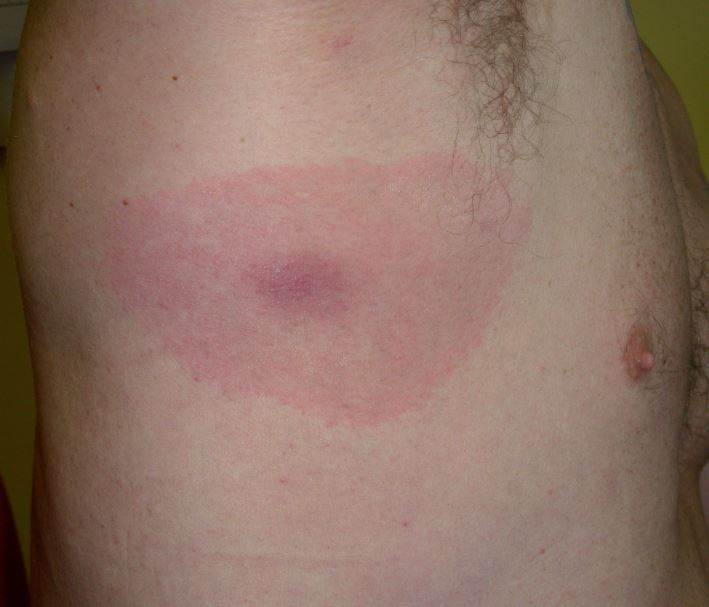
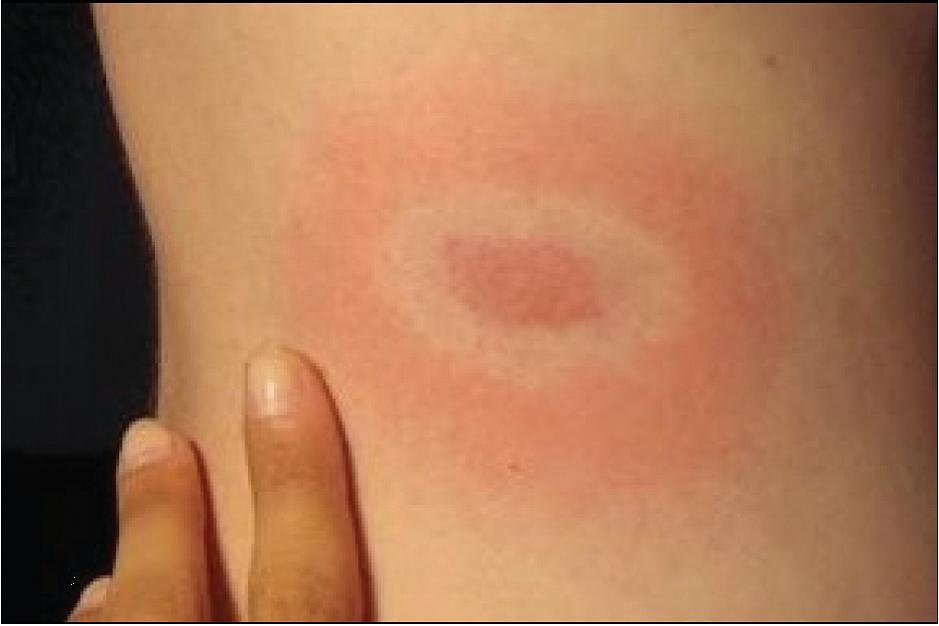
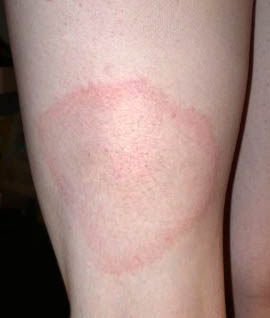
If you see a rash like the images above, take a photo and see your GP. Note that:
- The rash does not have to be circular.
- The rash can become very large (40cm across) with fading or patchy edges.
- There can be many rashes, not just one.
- The rash is not necessarily at the site of the tick bite.
- In UK studies around 1 in 3 of people did not see a rash, but the number who notice it may increase with increased publicity and awareness.
Immediately after an attached tick has been removed from the skin, the site of the bite will continue to be a little red, perhaps for a few days – this is not in itself an indication of Lyme disease, it is just a reaction to the tick bite and will fade.
The Lyme disease rash is called “erythema migrans”, which means redness spreading” and is often referred to as EM rash for short. The rash usually develops about 14 days after the bite, but it can be sooner or later.
See the NHS Clinical Knowledge Summaries website for skin rashes that can be confused with the Lyme disease EM rash.
More images with NICE Guideline
How else can Lyme disease affect the skin?
There are 2 other skin manifestations associated with Lyme disease.
Acrodermatitis Chronica Atrophicans (ACA)
This is an uncommon, bluish-red discolouration and swelling, on the surfaces of legs and arms, that develops several years after infection. It takes a chronically progressive course and finally leads to a widespread atrophy (wasting) of the skin in the area which has been described as “cigarette paper-like wrinkling of the skin”.
With ACA there is often associated peripheral neuropathy
Borrelia lymphocytoma
This is uncommon in Europe, and extremely rare in the US. It is a bluish-red, solitary swelling, with a diameter of up to a few centimetres, most often seen on ear lobes or nipples.
A publication Cutaneous Lyme borreliosis: Guideline of the German Dermatology Society[1] has some excellent images and discussions of the variability and differential diagnosis of Lyme disease skin manifestations.
References
- Hofmann et al 2017 Cutaneous Lyme borreliosis: Guideline of the German Dermatology Society GMS German Medical Science 2017,Vol.15, ISSN1612-3174
 Printer Friendly