The Dartmoor Hill Farm Project organised a feedback session to inform everyone of the results of their investigations across the moor. This has involved UK Health Security Agency (UKHSA), Animal and Plant Health Authority (APHA), Centre for Ecology and Hydrology (CEH) and the Moredun Research Institute (MRI).
The UpTick project is focussed on Ticks and Tick-Borne Diseases (TBDs), using the ‘one health’ approach. This links the environment, wildlife, livestock and human health to better understand how we can manage the diseases that affect us and our animals.
A lot of blood tests were carried out – on people, deer, sheep and cattle for current or past exposure to the main tick-borne diseases. Ticks have been collected, and tested, from many environments across Dartmoor.
We were first involved 2 years ago and it was good to return to Dartmoor and find out how it has all gone. The main conclusions reported by the project are in their project summary below.
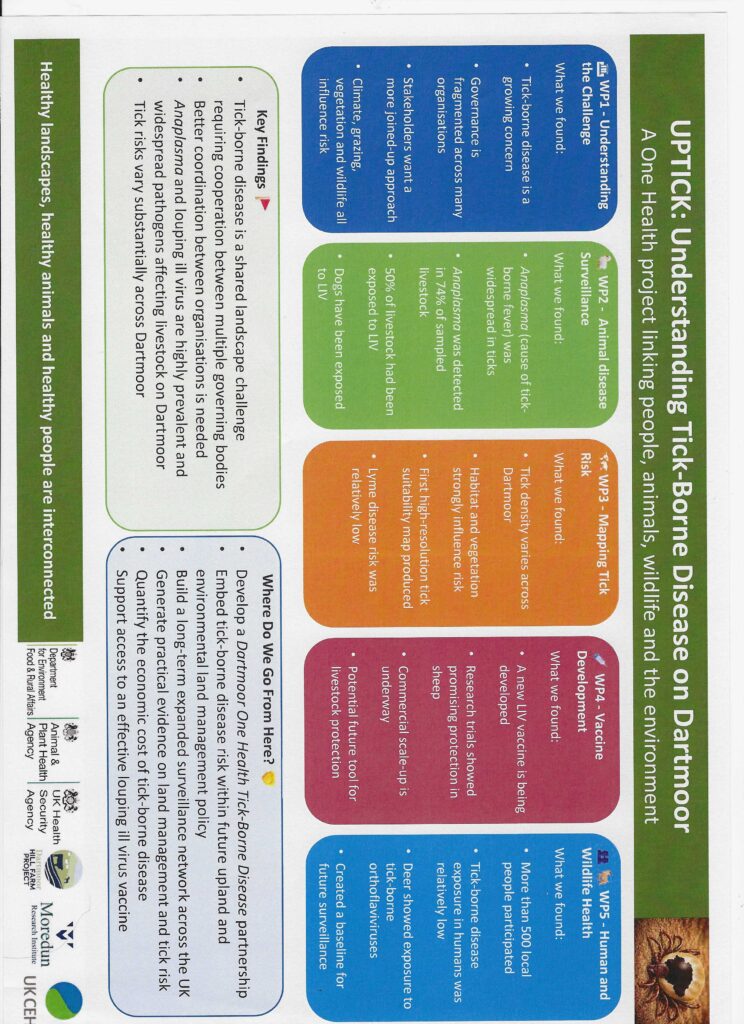
The main points we noted from this feedback day were:
- The involvement of government agencies has been good and has enabled major funding.
- In the Dartmoor group of patients tested for Lyme disease, more were positive than in the survey of national blood donors, but that is not surprising as these were people exposed to tick bites.
- There is concern about re-wilding & climate change leading to more ticks and TBDs, but this tends not to be mentioned in policies.
- Nearly 1 in 10 ticks collected were positive for Anaplasma – a bacteria that also causes human disease. This is much higher than the national average.
- The survey of ticks found that the risk of Lyme disease was less on moorland than in woodland.
The priorities quoted for the future will include a Dartmoor One Health Tick-Borne Disease Partnership and a commitment to ensure that tick-borne disease is incorporated into policies.
 Printer Friendly